Greetings, friends,
This week we are continuing our tradition of inviting members of our community to write from The Curator’s Desk, and for this edition, I’m happy to hand it over to our outgoing Communications and Marketing Manager, Lisa Muchangi. Lisa has been really crucial to Baraza Media Lab since we began, has been an integral part of the Africa Media Festival, and has been working behind the scenes to make sure this newsletter gets to you. Here’s Lisa, not with goodbye, more like, see you around.
As always, we’d love to hear from you; and if you have some thoughts you’d like to share with the community by contributing to the newsletter, feel free to reach out.
~Martie Mtange
I have spent enough time supporting this newsletter through its many seasons to know that finding the time to actually write for it can become its own small comedy. You spend months, years even, shaping the room, setting the table, moving things along, and then one day you realise you have not actually sat down in the room yourself.
So here I am, finally.
I am writing this piece in a season where so much of the world feels increasingly loud, sped up, and determined to flatten our attention into something reactive. We are living through a moment where journalism is being forced to defend its value once again, where institutions feel shakier than they are willing to admit, where so much of what reaches us online has been optimized for immediacy and spectacle, and where even our most ordinary acts of reading are being reshaped by platforms that want speed more than understanding. In that kind of atmosphere, the simple act of consuming media slowly, carefully, and with intention can start to feel like discipline. It starts to feel like one of the few remaining ways to keep your interior life from being chopped into pieces.
I’d even go so far as to say, maybe even resistance.
Not resistance in the performative sense of course. Not in the “look at me and my stack of serious books and collection of vinyls” sense either. I mean resistance as a way of staying awake and choosing depth in a time that keeps rewarding speed. Paying attention as resistance. Choosing to sit with a page, an article, a book, an album, a report, long enough for it to do something to your mind. Long enough for it to sharpen your questions instead of only feeding your reactions.
Working in media and creative ecosystems has shown me time and time again that people are still hungry for substance. For quality stories and media that respects their intelligence. They are still hungry for media that helps them make sense of themselves, their cities, this continent, and the world beyond the endless loop of breaking news. The way that I see it is that people have never stopped caring. The challenge is that we are all being asked to care through exhaustion. We are expected to think clearly while the feed refreshes every second, headlines compete for panic, our attention is treated like public property, and while the language of urgency gets used so often that it starts to collapse under its own overuse.
That is probably why I have been thinking so much about physical media lately, as a way of being with art, language, and attention more fully. Newspapers you can fold. Books you can underline. Magazines that stay on a table long enough to become part of the room. Albums you can listen to from start to finish, the way the artist intended, rather than as isolated tracks dropped into the endless churn. There is something grounding about being able to hold what you are engaging with, to return to it, to let it sit beside you long enough for it to gather meaning. Printed pages do not vanish because a platform changed its mind, an algorithm buried the link, or a timeline moved on. Physical media asks a little more of us, and gives a little more back. It slows the exchange down. It gives thought a surface. It gives ideas and feelings somewhere to settle. It reminds me that not all attention has to happen in a state of interruption, and that some of the most meaningful encounters we have with media still come when we let it take up space in our hands, our homes, and our lives.
And if I am being honest, this note is also arriving at a moment when I can feel one chapter drawing to a close and another beginning to make itself known. The last few years have changed the way I think about audiences, communities, and what it means to gather people around ideas that matter. I have spent a great deal of time building, curating, packaging, planning, and sending things out into the world, while paying close attention to what makes people return, what makes them trust, and what makes a room, a platform, a conversation, or a story feel worth entering and worth bringing other people into. That way of thinking will stay with me long after this particular season has passed, and it feels right to mark that now, while the lessons are still close enough to name.
What I know for sure is that I still care, deeply and without hesitation, about thoughtful media and the communities that gather around it. I care about stories, ideas, and spaces that earn people’s time, deepen their understanding, and make them feel a little less alone in the world. I care about work that enters conversation, lives in memory, and gives people something worth trusting, sharing, and carrying forward. In a time shaped by noise, speed, and constant interruption, that kind of work still matters enormously, and it is the work I will keep choosing.
And because this is Barua ya Baraza, it would be rude of me not to leave you with a few things currently keeping me company.
What I’m reading:
Road to the Country by Chigozie Obioma: It is the kind of book that understands how land, memory, grief, and belonging can live in the same body. It reminds you that the histories we inherit are rarely neat, and that literature can sometimes hold contradictions more honestly than any neat argument can.
What I’m watching:
Love on the Spectrum: I love it because it feels unusually gentle with people. It gives people room to be awkward, hopeful, vulnerable, funny, and fully themselves without turning that into spectacle. It reminded me that softness is not the opposite of seriousness.
What I’m listening to:
Brandy’s Full Moon has returned to my on-repeat rotation, exactly as it should. It is lush, emotional, a little dreamy, a little dangerous, and still one of the most gorgeously layered R&B albums to ever exist. Some albums do not age. They simply keep meeting you at different versions of yourself.
My best,
Lisa Muchangi
Outgoing Marketing and Communications Manager | Baraza Media Lab
Member Spotlight:
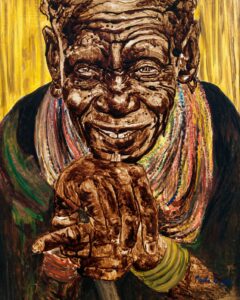
In the spirit of long reads, it’s only fair to do that with coffee. This week, we feature Mbatia Karanja, a Kenyan visual artist and the founder of Mbarts Gallery. He’s a Baraza member from Nakuru whose creative practice involves painting with coffee. Yes, coffee.
 Who is Mbatia Karanja in a nutshell?
Mbatia Karanja is a self-taught Kenyan visual artist and the founder of MBARTS GALLERY. I use different mediums for my art, though I specialize in coffee and acrylic painting, creating portraiture works that explore African culture, identity, and human experiences. My practice focuses on highlighting elements of life that would reflect strong values of humanity or just personalities that inspire.
Okay, what’s the story behind painting with coffee?
Coffee painting began as an exploration of both creativity and resourcefulness. Having grown up in an environment where coffee holds both cultural and economic significance, I found it meaningful to incorporate it into my work. Over time, coffee became more than just a medium; it became part of my artistic identity. Its natural earthy tones and organic texture allow me to create depth, warmth, and authenticity within my pieces. Through coffee painting, I aim to present African stories and experiences in a way that feels both innovative and deeply rooted in culture.
How is art important in your life, and what role do you believe it plays in creating a broader impact on the world?
Visual art is important to me because it serves as a powerful form of communication and cultural preservation. It has the ability to express emotion, document identity, and create meaningful dialogue across different audiences. Coffee painting, in particular, allows me to merge creativity with heritage, transforming a familiar everyday element into a storytelling tool.
I also believe art plays a vital role within any creative environment because it inspires thought, encourages innovation, and strengthens cultural appreciation. Beyond aesthetics, art has the capacity to influence spaces, shape conversations, and create emotional connections. In my work, I strive to create pieces that not only engage visually but also leave a lasting sense of meaning and reflection.
You can check out more of his work here.