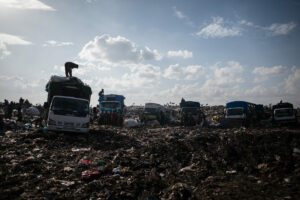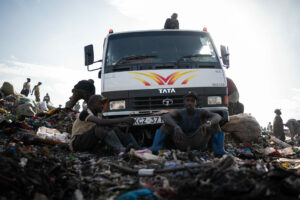
“One man’s waste is another man’s treasure.” is a quote that perfectly fits the Dandora Dumpsite. It is hills upon humongous hills that have smoke flowing up to the skies almost constantly, full of Nairobi’s waste in a landfill that got full and was supposed to be closed off two decades ago.
There’s birds flying around lazily, low enough for you to see their full bellies. This is abundance for them, the same type of abundance we’d hope for the children whose school shares a wall with the dumpsite. You’d hope that the constant view they have of endless trash won’t be what stands in the way of a bright future for them.
When you step in past the market gate, the smell of garbage hits you. A ripe smell, like rotting fruits. But every once in a while, as you go deeper into it, getting into the thick of it, a new smell hits your nose every once in a while. The same way taking a walk through any town means you will smell different things.This place is the size of a small town, and it tells the story of Nairobi, and of those who work inside it.
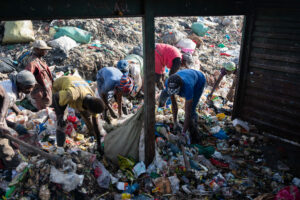
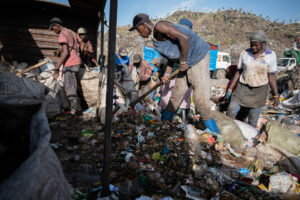
There’s a lot of women who work here, and there’s an interesting cohabitation connection between the humans, dogs, pigs, and marabou storks. Each one of them gets something from this place, and with connection comes interesting stories, like the one that says that if you kill the marabou storks for no reason, you won’t live a week. The rest of the storks gather around and make angry noises, cursing you for what you’ve done to one of them.
In a day, one woman can earn anything between twenty and one hundred shillings. They pick anything that can be of value, like plastic bottles and cups, nylon papers (they call it ‘white’ there), and glass bottles that aren’t broken. Some ladies like Nyambu pick any clothes they find, wash them, and sell them to hawkers.
Before, the earnings were not as bad. But when people picked up on trash being a profitable business, they started taking all the ‘good trash’ from the trucks immediately after picking them up from different buildings. Either that or they divert them away from the route to the dumpsite. So by the time trash gets to Dandora, there’s virtually nothing left to pick out, and with hungry mouths to feed, they sometimes have to resort to eating there too, that is if they find something like raw meat that they can wash and cook in the evening.
January to around September are the better months to find valuable things, but from October, with people travelling out of Nairobi for the holidays, work isn’t that good.
This means that you can’t afford to miss a day of work, quite literally. And even if you get injured at work, because even with gumboots, pieces of steel like nails could end up piercing you. What they do in this scenario is get a tetanus injection and go right back to work the next day with a bandaged foot.
Nyambu started working in the dumpsite when she was ten years old. Being the first born of seven kids, she had to help out her single mom to provide for the rest of the family, and now, fourteen years later, she’s a mother of two and is trying to make sure that her children get a chance at a proper education and a better life. Her mother still works at the dumpsite.
There’s little things you notice about people, like how even in situations that some of us view as the worst, they still make an effort to have some beauty in their lives. Like Nyambu, who has some eyeshadow and lipstick on her face, which bring out her features so well. That she takes time in the morning to do a bit of makeup before going to work, even when she’s slept at the dumpsite braving the cold wind so that she can wake up early and get to work.
The resilience that these Nairobians, even if they are surrounded by garbage, literally and figuratively, is something to be admired, even as we keep fighting for better waste management by the county government and better conditions for the workers.
Women like Nyambu deserve better, for their mothers, themselves, and their children.